Goal 1: I will understand what blended learning is
and explain the meaning and application.
To meet this goal, I will find quality resources on blended learning,
take notes, and create a blog post that will demonstrate my understand and
findings to share with my peers and instructor for feedback.
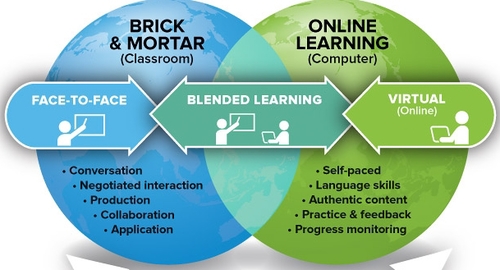
The Khan Academy resource was the best resource I found to explain blended learning. It takes you through the case for blended learning. They state that every 26 seconds a student is dropping out of high school. Blended learning can have the potential for students to take ownership of their learning at their own pace. Blended learning can help students be successful by using more than just the technology tools in the classroom.
The definition of blended learning is broken down to the 3 essential points. The definition of blended learning is “1- a formal education program in which a student learns at least in part through online learning, with some element of student control over time, place, path, and/or pace; 2- at least in part in a supervised brick-and mortar location away from home; 3- and the modalities along each student’s learning path within a course or subject are connected to provide an integrated learning experience”. The first part of the definition talks about the path and pace of students because they all learn at different speeds. Sometimes students can whip right through an assignment while others struggle and vice versa. The second part of the definition is that blended learning still takes place in a real school setting. The third part of the definition talks about what is happening online during blended learning is also being done in the classroom.
They went on to show three examples and discussed why or why not they fell into the blended learning category. Two of the examples were just using technology or technology tools in the classroom. The example that was a blended learning classroom was using a flipped classroom method.
The next videos took us through four types of blended learning. The first was a flipped classroom. A flipped classroom is the easiest way to get into the blended learning movement. The primary delivery of instruction of content is done online. So what has been done in the classroom traditionally is now being done at home and what has traditionally been done for homework is not done in class.
The next was the Station Rotation Model. This is where students rotate between stations at school. Some students begin with the teacher and then rotate to the computer for online learning. Other stations could include small-group, group project, or even paper-pencil assignments. They gave an example of a school that has 75 minutes between rotations of teacher and computer online learning.
Another blended learning model is a lab rotation. This is where students are still in traditional classrooms but will rotate out at specific times to the learning lab to work online individually at computers. It is similar to Station Rotation, but they rotate out to the lab for their online learning, not just in the classroom.
The last blended learning model is the Flex Model. This is where their is a central learning space where individuals are with computers to learn online. Then, around the perimeter there are break out rooms. This includes small groups, maybe a station for instruction or lab work, a social area to learn with other peers. This model allows students to flexibly move around and are not constrained to one area. They related this to a playlist in which students follow their own playlist to their own learning. For example, students take a quiz to see what they know. If they pass the quiz they may go take the test for mastery right away. If not, they can go through their own playlist to get to the mastery point.
To summarize, blended learning uses both face-to-face and virtual online instruction. It allows the students to work at their own pace and path. Blended learning is focused on engaging the students to personalize their individual instruction to increase student learning.
I also found this video on Blended Learning:
(https://vimeo.com/89546618)

I found blended learning to be fascinating and overwhelming. So many people and so many websites want to get a piece of the action to create and post interactive websites that it can become very confusing for the teacher to narrow it down for her students. One thing I have noticed from my own fourth grader is that the teachers have the parents and the students working with many different websites at once. I understand the excitement of it all. Whenever teachers find a new site that seems like it fits right into what the class is doing, they share it and it gets added to the list of all the other websites. After a while, I can see where people may just shut down. This is also why it is so easy to get caught in the web.
ReplyDeleteBlended learning is a terrific idea where students can work at their own pace. One thing that we, as educators, need to remember is that kids don't learn in the same way. There may be some students who work better with a teacher, rather than a self-guided lesson. Bottom line is, I'm glad there are options for everybody.